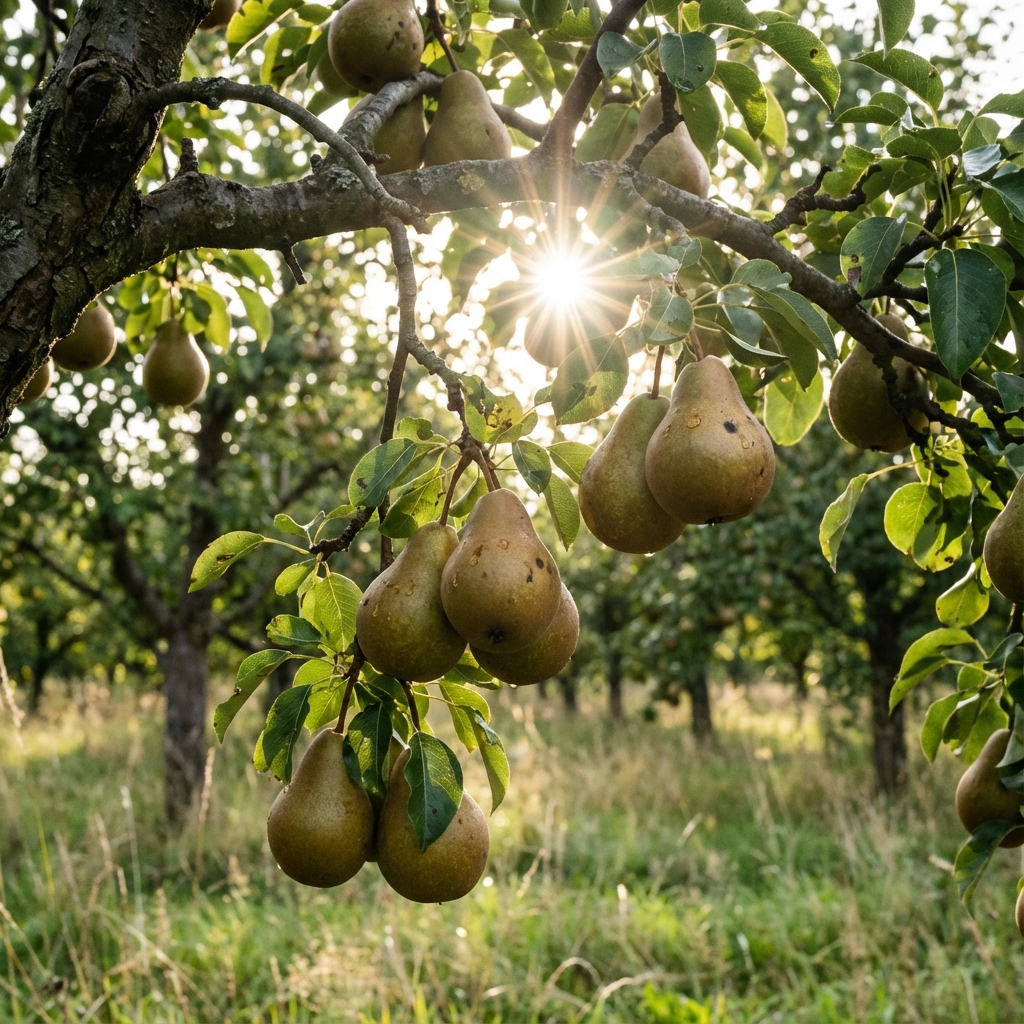
Pear
General Information About Pear
The pear is a pome fruit that can grow in almost every region of our country; it is sweet, juicy, and aromatic. Having white flowers, the pear belongs to the same family as apple and quince botanically. Since the edible fleshy part is formed by the swelling of the flower receptacle, pear falls into the "false fruit" group.
It is a nutritious and healthy fruit containing natural sugars and Vitamins A, B1, B2, and C. Originating from Anatolia, it spread to Europe. Historical sources indicate pear cultivation dates back to the Hittite period.
Pear production is generally done by grafting. Wild pear species known as "ahlat" (Pyrus elaeagnifolia) growing spontaneously in nature are transformed into culture pears by grafting quality varieties. Due to its taproot structure, the pear tree prefers deep, permeable, and nutrient-rich soils.
Pear trees, which become sensitive to diseases and pests if not maintained regularly, are quite productive under correct growing conditions, yielding between 50–400 kg per tree. It is among the drought-tolerant fruit species.
The leaves of the pear tree, which can grow up to 7–8 meters, are simple, bright green, and finely toothed. Its white flowers blooming in spring resemble wild roses.
Besides fresh consumption, pear is used in making jams, marmalades, desserts, juices, liqueurs, and distilled beverages. Also, the reddish wood of the pear tree is valuable in fine carpentry due to easy processing and good polishing.
For dwarf pear cultivation in shallower soils, quince rootstocks are used, and pears are grafted onto these rootstocks. However, pears on quince rootstocks are more sensitive to cold and require regular irrigation.
Turkey ranks high in world pear production and is one of the important producer countries after China, USA, Italy, and Argentina.
Pear Rootstocks
Fox 9
A semi-dwarf, productive rootstock improving fruit quality. Tolerant to calcareous and high pH soils. Compatible with most pear varieties, induces early fruiting, suitable for high-density planting.
Farold 87
Grows about 70% of standard seedling rootstock. Resistant to cold climate conditions and fire blight. Compatible with Asian pear varieties.
Fox 11
A semi-dwarf rootstock of medium vigor. Adapts to different soil types thanks to its strong root structure. Tolerant to calcareous soils, enhances yield.
Farold 40
Ideal for organic-rich and permeable soils. Resistant to fire blight, compatible with European pear varieties. Suitable for medium and high-density planting.
OHF 333
Medium vigor. Resistant to fire blight but not suitable for calcareous and heavy soils. May reduce fruit size and yield in some varieties.
Quince A
Quince-origin, medium vigor rootstock. Induces early fruiting, suitable for high density. Since it may show incompatibility with some pear varieties, an interstock may be needed.
Quince C
Dwarf growth, requires trellis support system. Sensitive to calcareous and dry soils.
Quince BA 29
Semi-dwarf growth, positive effect on yield and fruit quality. Tolerant to heavy and water-retentive soils. Starts yielding from the 2nd year.
Climate and Soil Requirements for Pear
Climate Requirements
Pear is less cold-hardy than apple. Flowers can be damaged at -2.2 °C and young fruits at -1.1 °C. Late spring frosts are a major risk. It requires 1200–1500 chilling hours below 7.2 °C during winter dormancy.
Soil Requirements
Pear adapts to different soil conditions but performs best in deep, permeable, warm, and organic-rich soils. Iron deficiency (chlorosis) can be seen in shallow and high-lime soils, especially on quince rootstocks. Therefore, soil analysis should be done before orchard establishment.
Pear Özellikleri
- Sertifikalı ve İsmine Doğru
- Yüksek Verim Potansiyeli
- Virüsten Ari Üretim