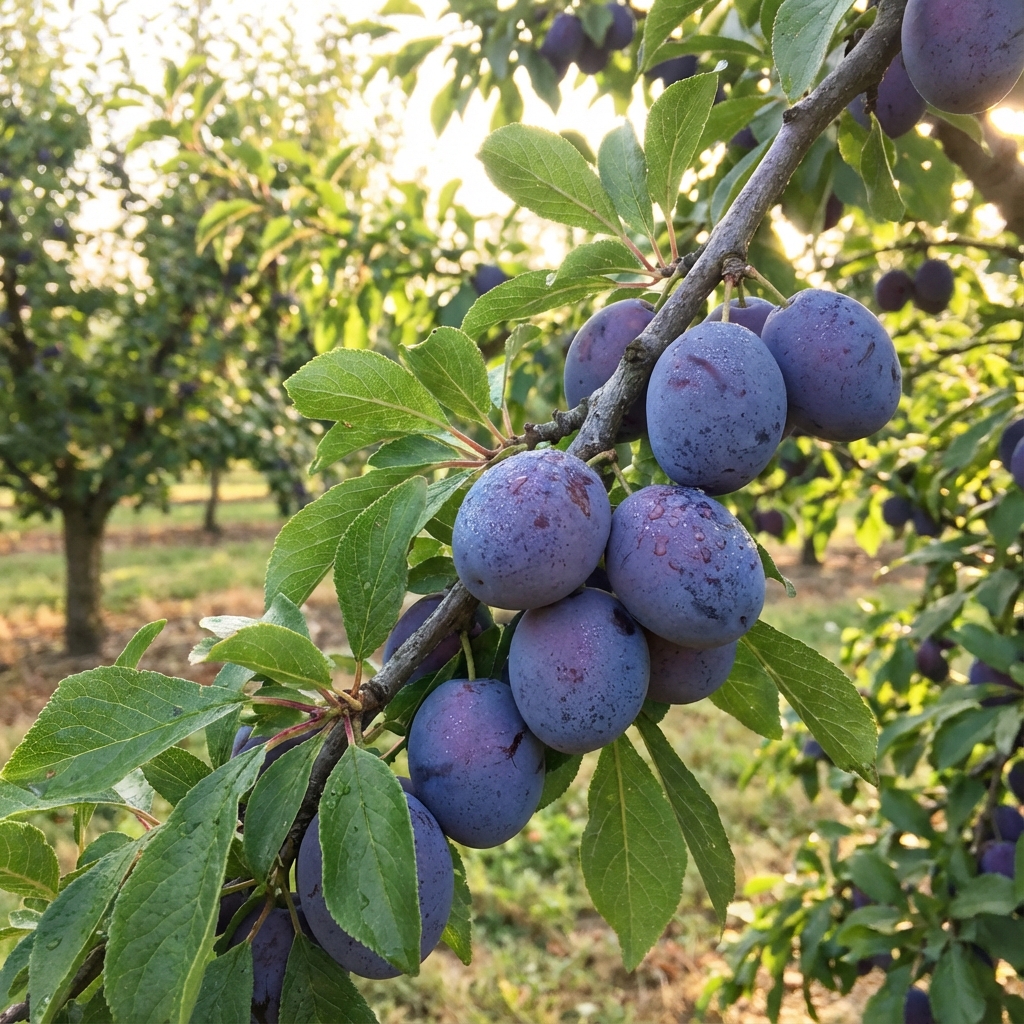
Plum
General Information About Plum
Plum (Prunus spp.) belongs to the Rosaceae family with a rich variety of species. Three main groups: Asian-European, Japanese-Chinese, and North American.
In Turkey, plum can be grown successfully in almost every region except high plateaus of East Anatolia and extremely hot/dry areas of SE Anatolia. Widely adapted.
Harvest time spreads throughout the year. Early "Can" plums in spring, Japanese plums in mid-summer, European plums from August to October.
Common Turkish varieties: Can, Papaz, Damson (Mürdüm). Origin considered Anatolia, Caucasus, Caspian.
Plum Rootstocks
Myrobolan 29 C
Semi-dwarf, adapts to many soils including heavy/calcareous. Resistant to nematodes. Induces early fruiting. Also used for apricots.
Marianna 2624
Weaker vigor than Myrobolan. High resistance to heavy/clay soils and nematodes. Sensitive to bacterial canker.
Pixy
Dwarf (40-50%). Needs good, well-drained soil. Suitable for high density. Requires good irrigation/care.
Marianna GF 8/1
Shallower roots. Suitable for soils with high water holding capacity.
Climate and Soil Requirements for Plum
Climate Requirements
Can be grown in temperate to cool-temperate climates. Early blooming varieties are sensitive to spring frosts.
Irrigation improves fruit size and quality even in regions with decent rainfall.
Soil Requirements
Moderately selective. Japanese plums prefer humus-rich, warm soils; European plums do better in heavy/clay soils. Perform better in poor drainage than other stone fruits. pH 6.5–7 is optimal.
Plum Özellikleri
- Sertifikalı ve İsmine Doğru
- Yüksek Verim Potansiyeli
- Virüsten Ari Üretim